How Hard Is Pyramid Solitaire?
Harder than it looks. With the usual three passes through the deck, about two out of three deals can be won, and only if you play every move right. Play without thinking ahead and you'll win about one game in three.
The short answer
With perfect play, 66.5% of random deals can be won with three passes through the deck. With one pass it's 3.5%, with no limit 67.6%. If the whole deck has to go as well, only about 1 deal in 20 can be won.
The Odds for Every Rule
We took 10,000 random deals and worked out, for each one, whether it can be won at all. Here's the share of deals that can, when you win by clearing the pyramid:
| Passes through the deck | Best possible | Simple play |
|---|---|---|
| 1 pass | 3.5% | 0.7% |
| 2 passes | 49.1% | 12.2% |
| 3 passes (the standard) | 66.5% | 33.4% |
| No limit | 67.6% | 40.2% |
Look at what each extra pass does. With one pass, hardly any deal can be won: about 1 in 30. A second pass changes everything and makes about half of all deals winnable. The third adds another 17 in every 100. After that, going on forever barely helps: 67.6% instead of 66.5%. So the three-pass rule gives you nearly every win there is, and it still makes you think.
The strict rule, where the deck has to go as well, is a different story. Every deck card then needs a partner in the pyramid, and most deals simply don't have enough of them:
| Passes through the deck | Best possible |
|---|---|
| 1 pass | 0.1% |
| 2 passes | 3.6% |
| 3 passes | 5.0% |
| No limit | 5.0% |
You can try both rules yourself: the number of passes and "All 52 are gone" are in the game's Settings.
How We Worked It Out
We used the solver that's built into our game, the same one behind the hint button. For every deal it tries the moves in every possible order, until it finds a way to win or has proved there isn't one. We ran it on the same 10,000 random deals for every rule, so the numbers can be compared fairly.
A handful of deals have so many possible move orders that the solver couldn't finish them in the time we gave it: just 5 of the 10,000 with three passes. We didn't count those as wins, so the real odds could be a hair higher, but by no more than 0.05%.
The simple player in the first table takes every King at once, then any pair inside the pyramid, then a pair with the waste card. When there's nothing to pair, it turns over the next card. It never looks ahead. That's roughly how most of us play our first games.
All numbers use the rules of this game, where only one deck card lies face up at a time, so two deck cards can never be paired with each other. In versions where they can, more deals can be won.
Why So Many Deals Can't Be Won
The top card is the key. All 27 other pyramid cards lie on top of it, so it's the very last card you can reach. By then, the only partner it can still get is a card from the deck. If the top card is a 7 and all four 6s are in the pyramid, the deal is lost before you make a single move.
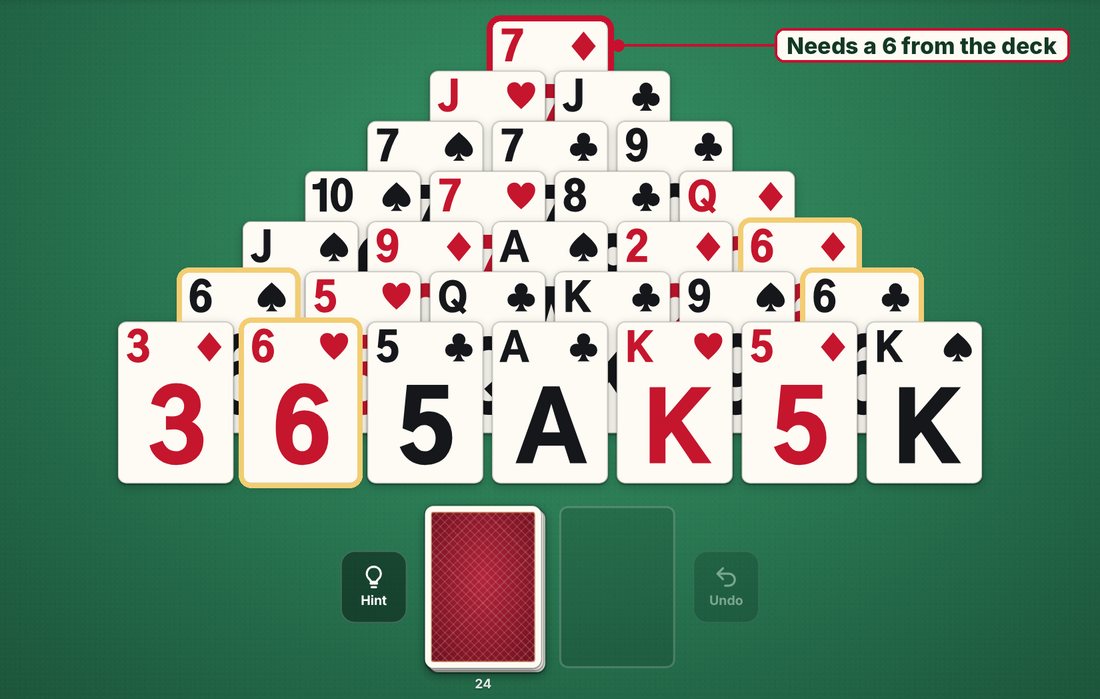
That happens in about 1 deal in 15: we counted 6.6% of 200,000 random deals. The same can happen to any card whose four partners all lie on top of it. Count those too, and about 1 deal in 10 (10.6%) is lost before the first move. The rest of the lost deals go wrong later on, when the cards you need are stuck in the wrong place at the wrong time.
What This Means When You Play
- Lost a game on Hard? There's a fair chance nobody could have won it. Ask for a hint: when a deal can't be won anymore from where you are, the hint tells you so.
- Want only deals you can win? Pick Easy or Medium. Every deal on those levels has been checked. Easy deals can be won with plain play, Medium deals need some thinking ahead.
- Want to win more of the hard ones? Our strategy tips come from the same 10,000 deals. Three simple habits took the computer from one win in four to more than one in three.
How Pyramid Compares
For comparison: in FreeCell nearly every deal can be won. Of the 32,000 numbered deals in the classic Windows version, only one, game 11982, has no solution. Pyramid leans far more on the luck of the deal. That's exactly why a win on Hard feels so good.
New to the game? Start with how to play Pyramid Solitaire, or find more answers in our FAQ.