How to Play Pyramid Solitaire
Pyramid Solitaire takes about a minute to learn. You lay out a pyramid of 28 cards and take it apart, two cards at a time. Every pair has to add up to 13. Clear the whole pyramid and you've won.
The rules in short
- Deal 28 cards face up in a pyramid of seven rows. The other 24 cards are the deck.
- Number cards count as their number. An Ace is 1, a Jack 11, a Queen 12 and a King 13.
- Take away any two cards that add up to 13. A King goes on its own.
- You can only use a card when nothing lies on top of it.
- Stuck? Turn over the next card of the deck. If it makes 13 with a free card in the pyramid, pair them up.
- Go through the deck up to three times. Clear the pyramid and you win.
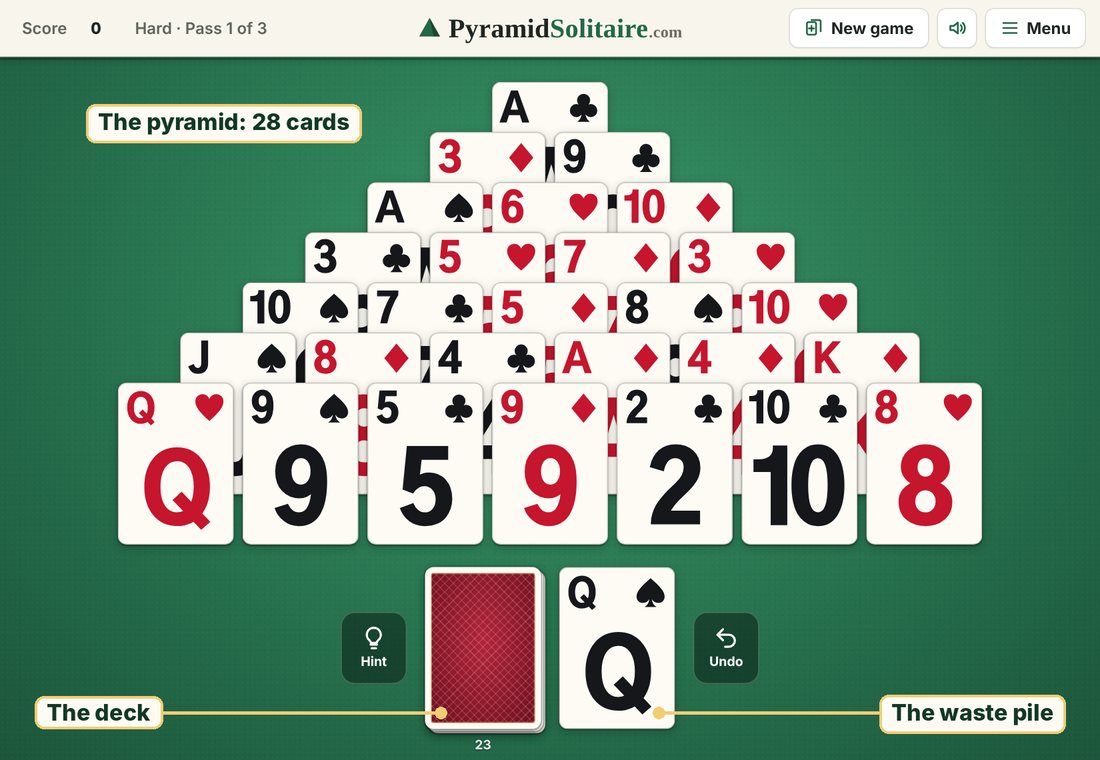
Watch: Pyramid Solitaire in 2 Minutes
New to Pyramid? This short video plays a whole game with you, from the first pair to the last card. The full rules are below.
 Video coming soon
Setting Up the Pyramid
You need one ordinary deck of 52 cards, without jokers. Shuffle well, then deal 28 cards face up in seven rows: one card at the top, two in the next row, then three, four, five, six and finally seven at the bottom.
Each row overlaps the row above it. Every card covers part of the two cards just above it, the way bricks sit in a wall. When you're done, the seven cards of the bottom row are the only ones you can see in full.
The 24 cards you have left are the deck. Keep them face down. During the game you'll turn them over one at a time onto a waste pile next to the deck.
Playing here on the site? The game deals for you, so you can skip straight to the fun part.
What the Cards Are Worth
Number cards count their own value, so a 7 is worth 7. The Ace and the picture cards count like this: Ace 1, Jack 11, Queen 12 and King 13. That gives you exactly seven ways to make 13:
- Ace and Queen:1 + 12
- 2 and Jack:2 + 11
- 3 and 10:3 + 10
- 4 and 9:4 + 9
- 5 and 8:5 + 8
- 6 and 7:6 + 7
- King:13
Suits and colors don't matter at all. A red 9 goes with a black 4 just as well as with a red one.
Why 13? It's the King's number, the highest in the deck. Every other card has one partner that brings it up to 13, and the King gets there all by itself. Here's a nice bit of math: add up all 52 cards and you get 364, which is exactly 28 times 13. The whole deck splits into 24 pairs and 4 Kings, with nothing left over.
Which Cards You Can Use
A card is free when nothing lies on top of it, and only free cards can be paired. At the start of a game that means the seven cards in the bottom row.
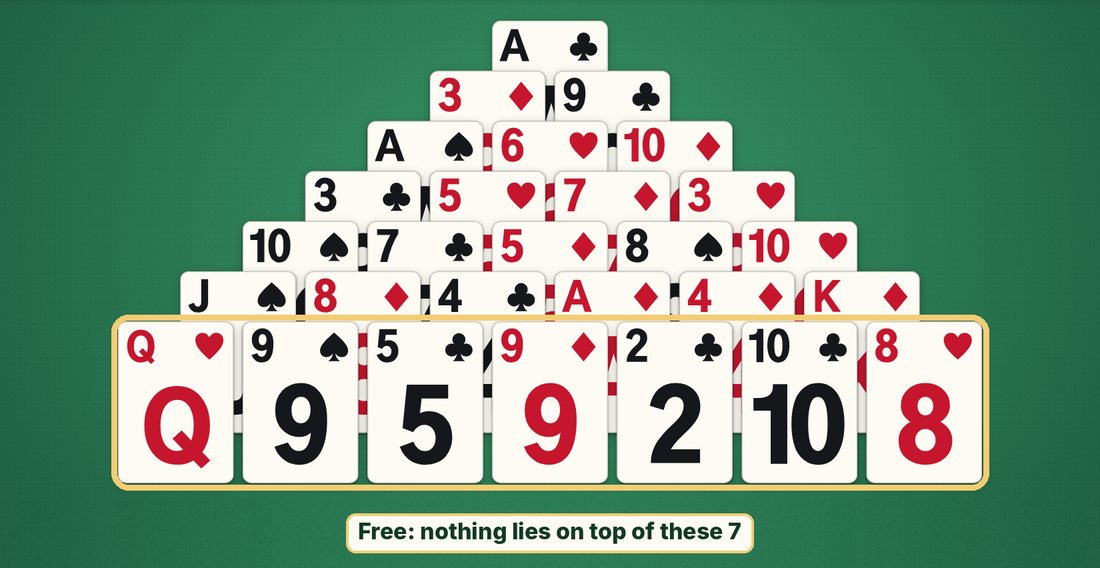
A card higher up comes free once the two cards just below it are gone. So when you take away two cards that sit side by side, the card they were both covering opens up.
This is the one rule that trips up most new players: taking away one of those two cards isn't enough. Both have to go.
The top card of the waste pile is always free too. It can pair with any free pyramid card that makes 13 with it.
Making a Pair
Click or tap a card, then click its partner. Both cards leave the table together. You can also drag one card onto the other if you like that better. A King goes with a single click, because it doesn't need a partner.

Picked the wrong card? Click it again and it's put back.
The Deck and the Waste Pile
When you can't find a pair in the pyramid, click the deck. Its top card turns over onto the waste pile. If that card makes 13 with a free card in the pyramid, pair them up.

Only the top card of the waste pile can be used. As soon as you turn over the next card, the one before it is buried underneath. That's also why two cards from the deck can never be paired with each other: every deck card needs a partner in the pyramid.
When the deck runs out, click it again to turn the waste pile back over. You go through the same cards again, in the same order. You get three passes through the deck in all. If you'd like it harder or easier, you can pick 1 pass or no limit in Settings.
How You Win
You win the moment the last card of the pyramid is gone. Cards left in the deck or on the waste pile don't count against you.
Some old card books use a stricter rule: you only win when all 52 cards are gone, deck included. If you're up for that, pick "All 52 are gone" in Settings. Fair warning: only about 1 deal in 20 can be won that way.
When your passes are used up and no pair is left, the game is over. Undo has no limit, though, so you can always step back and try a different way. And if you wonder whether a deal can be won at all, our page on how hard Pyramid Solitaire is has the answer.
Scoring
Every pair and every King is worth 5 points. Clearing a whole row earns a bonus on top, and the higher the row, the bigger the bonus:
| Row you clear | Bonus |
|---|---|
| The bottom row (7 cards) | 25 |
| The row of 6 | 50 |
| The row of 5 | 75 |
| The row of 4 | 100 |
| The row of 3 | 150 |
| The row of 2 | 250 |
| The top card | 500 |
Win within 10 minutes and you get a time bonus as well: one point for every second you have left. The clock starts hidden, so nobody's rushing you. To see your time, turn it on in Settings.
Your best score, your fastest win and your longest winning streak are kept under Statistics in the menu.
Rules That Change From Game to Game
Pyramid has no official rulebook, so you'll see small differences from one version to the next. These are the ones you're most likely to run into:
- How many passes. Older card books allow just one trip through the deck. Many versions today allow more. Here you get three, and you can change that.
- Clearing the deck too. The strict rule says you only win when all 52 cards are gone. Plenty of people play until the pyramid is clear instead, and that's how this game works unless you change it.
- Pairing two deck cards. In some versions, like the one in Microsoft Solitaire Collection, the top card of the deck lies face up, so it can be paired with the waste card. Here the deck lies face down, the classic way.
- Relaxed Pyramid. Some books use this name for the version where only the pyramid has to be cleared.
Got the hang of it? Our strategy tips will help you win more of your games.