Pyramid Solitaire Strategy and Tips
Pyramid looks like a game of pure luck. It isn't. We had a computer play the same 10,000 deals in different ways, and the way it picked its pairs made a big difference to how many games it won.
| How the computer played | Games won |
|---|---|
| Took pairs with the waste card first | 25.1% |
| Took any pair it saw | 28.6% |
| Took pairs inside the pyramid first | 33.4% |
| ... and picked the pair that frees a card | 35.0% |
| ... and kept a deck card for the top card | 36.9% |
| Perfect play, every move thought through to the end | 66.5% |
Three simple habits took the computer from one win in four to more than one in three. Perfect play wins about two games in three, because it looks all the way ahead. You won't play perfectly (nobody does), but every tip below moves you a step closer.
1. Take a Look Before Your First Move
Give the pyramid ten seconds before you touch a card. Which card sits at the top, and which partner will it need? Are there cards with most of their partners piled on top of them? Which pairs in the bottom row would open up the most? You'll find out why these questions matter in the tips below.
2. Take Kings Right Away
A King never needs a partner, so taking it away costs you nothing. It can only open up the cards underneath. There's never a reason to wait.
3. Pair Pyramid Cards Before the Waste Card
This habit made the biggest difference in our test. When you can make a pair inside the pyramid and also a pair with the waste card, take the pyramid pair first. Playing that way, the computer won 33.4% of its games. When it reached for the waste card first, it won only 25.1%.
The reason is simple. You have to clear the pyramid, not the deck. A pair inside the pyramid takes away two pyramid cards, a pair with the waste card only one. And a waste card you skip isn't gone for good: as long as you have a pass left, it comes around again.
4. Choose the Pair That Opens Up a Card
Often you'll have two or three pairs to choose from. Take the one that frees a new card. Two cards side by side in the same row uncover the card above them, which gives you one more card to work with and maybe one more pair. In our test this habit lifted the computer from 33.4% to 35.0%.
5. Check the Waste Card Before You Turn the Next One
Before you click the deck, look at the waste card one more time. Once you turn over the next card, it's buried until your next pass, and on your last pass it's gone for good. If it fits a free card and you've made the pyramid pairs you wanted, use it now.
6. Save a Deck Card for the Top Card
The top card is special. All 27 other pyramid cards lie on top of it, so it's the very last card you can reach. By then there's nothing left in the pyramid to pair it with, so its partner has to come from the deck.
Say the top card is a 5. Then you'll need an 8 from the deck at the very end. So keep an eye on the 8s that leave the deck. If the waste card is the last 8 outside the pyramid, think twice before you pair it with something else. This one habit took the computer from 35.0% to 36.9%.
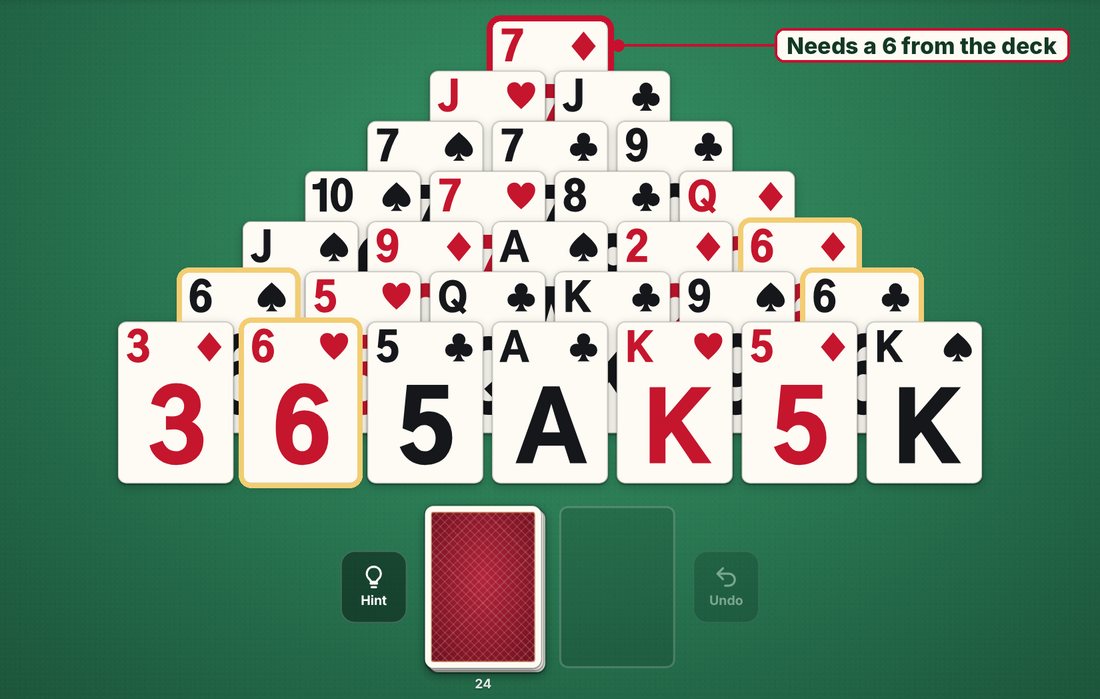
It also explains a hard truth. If all four partners of the top card are in the pyramid, the deal can't be won, whatever you do. That happens in about 1 game in 15.
7. Watch for Cards That Bury Their Own Partners
The same trap can hide lower down. A card can never pair with a card that lies on top of it, because the card on top has to go first. So when most of a card's partners are piled on top of it, plan to pair it with a card from the deck, and don't spend those deck cards on something else.
When all four partners lie on top of a card, it's stuck for good. We checked 200,000 random deals, and about 1 in 10 had a card like that. Those games were lost before the first move.
8. Remember What's in the Deck
You go through the deck up to three times, and the cards always come in the same order. So after your first pass you know what's coming. Use it. If you know two 8s are on their way, you can keep your free 5s for them and use other cards now.
9. Let Undo and the Hint Button Teach You
Undo has no limit here and nothing counts against you, so use it to learn. Not sure which of two pairs is better? Try one, see where it leads, then undo and try the other.
The hint button thinks ahead before it suggests a move. And when a deal can't be won anymore from where you are, it tells you so, which saves you from playing on in vain.
10. Pick the Level That Fits Your Mood
On Easy every deal can be won with plain, sensible play, which makes it a good place to practice these habits. On Medium every deal can still be won, but only if you look ahead, so it's perfect for tips 4 to 8. On Hard you get real random deals, and about one in three can't be won at all. So don't blame yourself for every loss.
Curious how the odds change with one pass, no limit or the strict rule where all 52 cards have to go? Read how hard Pyramid Solitaire really is. New to the game? Start with how to play.